Guide
How to Select the Right Temperature Probe for Harsh Environments
Thermocouple, PT100 or thermistor? A practical framework for choosing probes that survive heat, cold and chemical exposure.
The Eltek Engineering Team9 min read
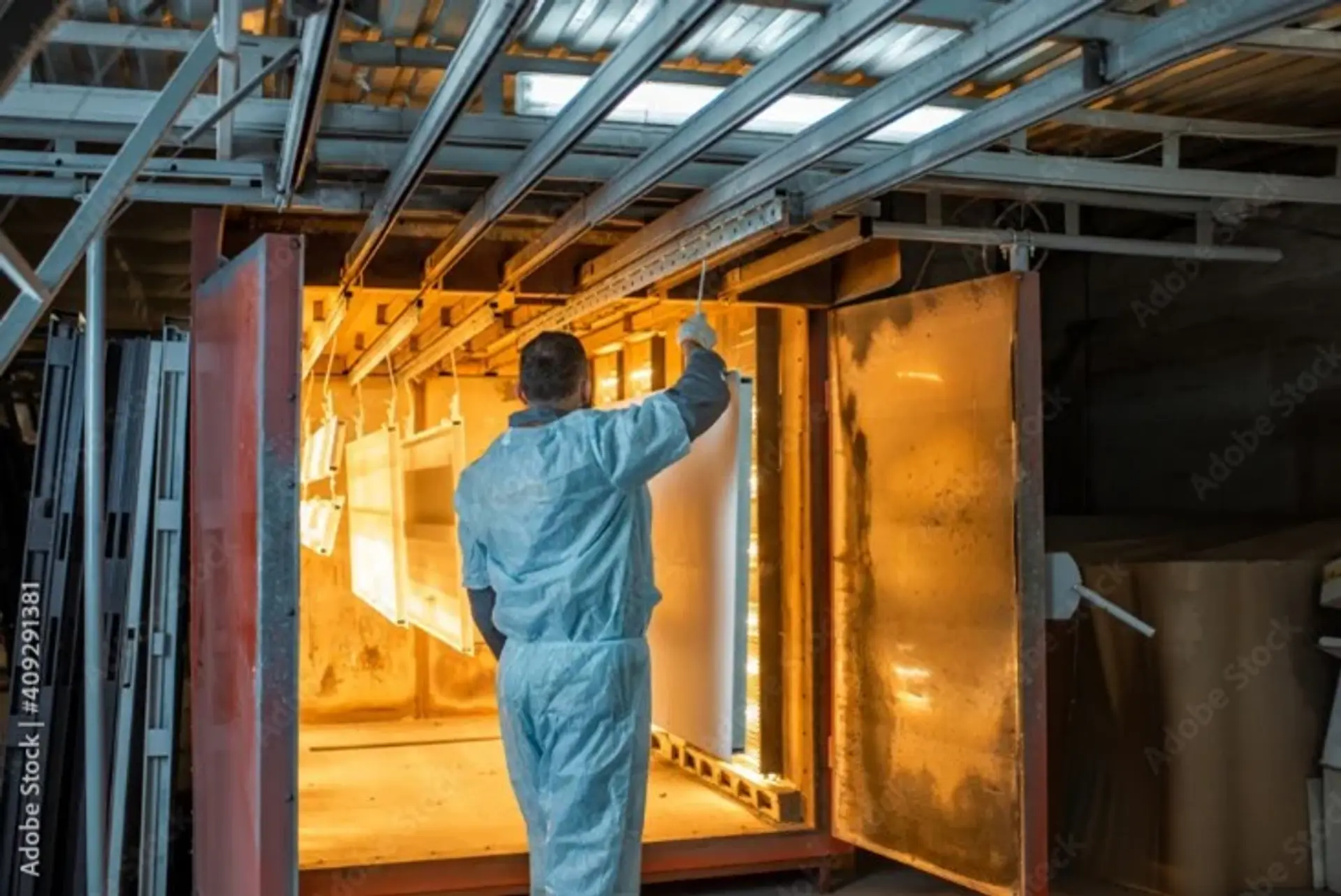
A temperature probe that reads perfectly on the bench can fail in a week on a curing line, in a cold store, or beside an engine under test. Harsh environments punish the wrong choice, with drift, with corrosion, with a lead that goes brittle and snaps, and the cost isn’t just the probe. It’s the readings you trusted while it was quietly wrong. Choosing well starts long before you pick a part number.
Start with the environment, not the probe
Before comparing sensor types, write down what the probe has to live through. Five questions carry most of the decision:
- Temperature range, the true minimum and maximum, including start-up, defrost and fault conditions, not just the normal set point.
- Accuracy and stability, how tight a tolerance you must hold, and for how long between calibrations.
- The medium, air, liquid, a solid surface, a moving product, a gas stream? It changes response time and mounting.
- Physical and chemical stress, moisture, wash-down, solvents, steam, vibration, pressure, abrasion.
- Response speed, do you need to catch fast transients, or track a slow, stable process?
With those in hand, the sensor type usually chooses itself.
The three main temperature sensor types
Almost all industrial and life-science temperature measurement comes down to three technologies. Each has a sweet spot.
Thermocouples: the widest range and the toughest
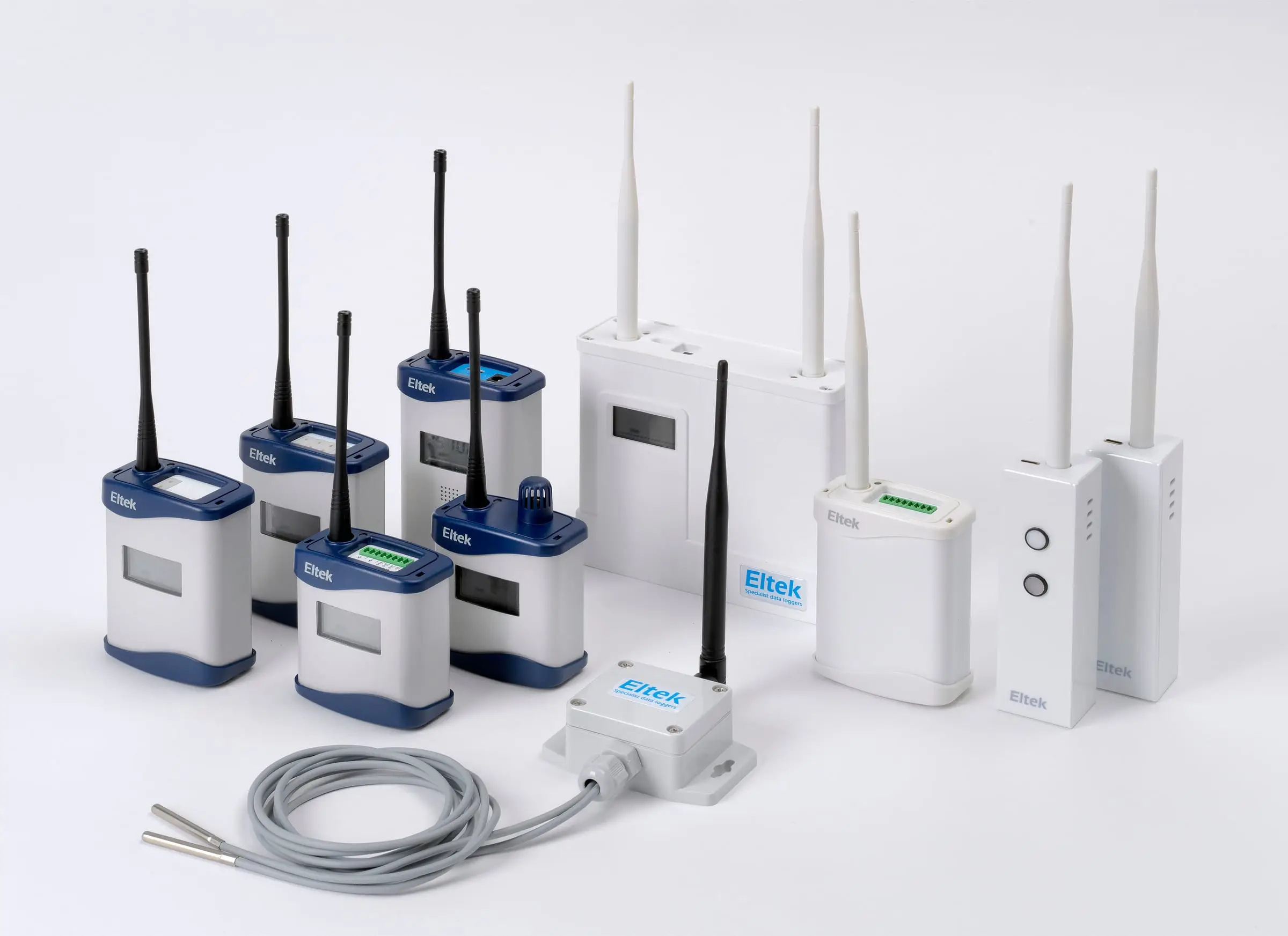
A thermocouple generates a small voltage from the junction of two dissimilar metals. It is simple, rugged and spans an enormous range: a Type K thermocouple measures from deep sub-zero to well beyond 1000 °C, which makes it the default for the hottest and most demanding environments: ovens, furnaces, curing and combustion. The trade-off is slightly lower absolute accuracy than an RTD, and a need for correct cabling and cold-junction handling. Eltek offers Type K thermocouple probes in stainless-steel sheaths on PTFE-insulated leads; the GD24H GenII transmitter accepts up to four K/T thermocouple inputs (across a −200 to +200 °C input range), and Eltek’s Squirrel loggers extend thermocouple measurement further where the process demands it.
PT100 RTDs: the highest accuracy and stability
A resistance temperature detector (RTD), most commonly a PT100, measures the change in resistance of a platinum element. It is the choice when accuracy and long-term stability matter most, across validation, calibration references and tightly controlled processes, and it holds its calibration well over time. Eltek’s GD52A transmitter takes two 4-wire PT100 (RTD) inputs across a −200 to +400 °C range, and the SQ16Plus logger supports both 3- and 4-wire PT resistance probes to deliver the best temperature accuracy. Use 4-wire wiring wherever you can: it cancels the error introduced by long lead resistance, which is exactly the kind of error that creeps in on a real installation.
Thermistors: sensitive and fast in a narrower band
A thermistor’s resistance changes sharply with temperature, giving high sensitivity and fast response in the moderate ranges that dominate cold-chain, laboratory and building monitoring. It is cost-effective and precise within its band, though less linear and narrower in range than a thermocouple or RTD. Eltek’s thermistor probes come in stainless-steel and copper surface-tab forms on 3 m and 10 m PTFE leads, and pair with GenII transmitters such as the four-input GD34, a common, dependable choice for freezers, incubators, galleries and stores. For a worked example of thermistor probes in physiological research, see our sports-science skin-temperature case study.
Beyond the sensing element: what actually survives
Two probes with the same sensor can have completely different lifespans in a harsh environment. The difference is in the packaging:
- Sheath material. Stainless steel resists corrosion and abrasion; the sheath, not the element, is your first line of defence against the medium.
- Ingress protection (IP rating). Wash-down, condensation and outdoor exposure demand a sealed probe and, often, a sealed enclosure for the transmitter. For outdoor and exposed points, Eltek offers IP65-rated external transmitter housings.
- Lead and insulation. PTFE-insulated leads tolerate heat, moisture and many chemicals far better than standard PVC; lead length also affects error on RTDs, so specify it deliberately.
- Connector and strain relief. The connector and the point where the lead meets the probe are the usual failure points under vibration and repeated handling. Robust connectors and good strain relief matter more than they look.
- Mounting. Surface, immersion or air, and whether the mount itself conducts heat away and biases the reading.
Calibration and traceability: the part auditors ask about
In a regulated or quality-critical environment, an uncalibrated probe is an unsubstantiated reading. Whatever sensor you choose, insist on calibration traceable to national standards, ideally performed by, or against, a UKAS-accredited laboratory, and put probes on a defined re-calibration schedule appropriate to their duty. Thermocouples generally drift faster than RTDs, so harsh-duty thermocouples earn tighter intervals. Building that cadence into your quality system turns calibration from a scramble before an audit into routine evidence.
Matching probes to your logger
A probe is only as good as the instrument reading it. That’s why Eltek specifies the two together: the GenII transmitter or Squirrel logger sets the input types, the number of channels and the achievable accuracy, and the probe is chosen to suit both the environment and that input. It’s also why the most reliable route to the right probe is to describe the application rather than order a part in isolation: the same −40 °C set point means something very different in a sealed freezer than on an exposed rooftop. Eltek’s Darca Solutions Suite carries thermocouple, PT100 and thermistor inputs across its transmitter range, so one system can cover a mix of duties on a single site.
A selection checklist
- Define the real range, including fault and start-up extremes.
- Set the accuracy and stability you must hold, and for how long.
- Pick the sensor type: thermocouple (widest/hottest), PT100 (most accurate/stable), thermistor (sensitive, moderate range).
- Specify sheath, IP rating, lead type and length, and connector for the environment.
- Confirm the logger/transmitter input matches, and use 4-wire for PT100.
- Require traceable calibration and set a re-calibration interval.
- Where a point is critical, plan redundancy so one probe failure isn’t a blind spot.
Get the probe right and everything downstream, your alarms, your trends, your audit record, inherits that quality. Get it wrong and no amount of clever software recovers a reading that was never accurate. If you’re specifying for a demanding environment, see how Eltek supports industrial process monitoring and life-science storage, or talk it through with our engineers.
Key takeaways
- Choose the sensor type by range and accuracy: thermocouples for the widest/hottest, PT100 RTDs for the highest stability, thermistors for sensitivity in a narrower band.
- The sensing element is only half the decision: sheath, ingress protection, lead and connector decide whether the probe survives the environment.
- Match the probe to the logger or transmitter input range: Eltek’s GenII transmitters accept thermocouple, PT100 and thermistor inputs; the SQ16Plus supports 3- and 4-wire PT100 for best accuracy.
- Insist on calibration traceable to national standards (ideally UKAS-accredited) and re-calibrate on a defined schedule.
- When in doubt, describe the environment, not the part number, and let an engineer specify against it.
Need this in your facility?
Send us your temperature range, the medium you’re measuring and the environment it lives in, and our UK engineers will specify a probe and logger that will survive it and stay accurate.
Get a probe recommendationGet more insights like this
Get monitoring insights in your inbox
Practical guidance on compliance and environmental monitoring: mapping, audit trails, probe selection and multi-site reliability. Occasional, useful, no noise.
Unsubscribe any time. Your details are never shared.