Insight
How Wireless Mesh Networks Improve Measurement Reliability
Why a resilient wireless mesh keeps data flowing across large, obstructed sites, and what that means for the readings you can trust.
The Eltek Engineering Team8 min read
In environmental monitoring, the reading you never took is often the one that mattered. A freezer that drifted overnight, a gallery that spiked while the building was empty, a process that ran out of spec for twenty minutes: the value of a monitoring system is measured by the gaps it doesn’t leave. That makes the wireless network carrying your data every bit as important as the sensors taking it.
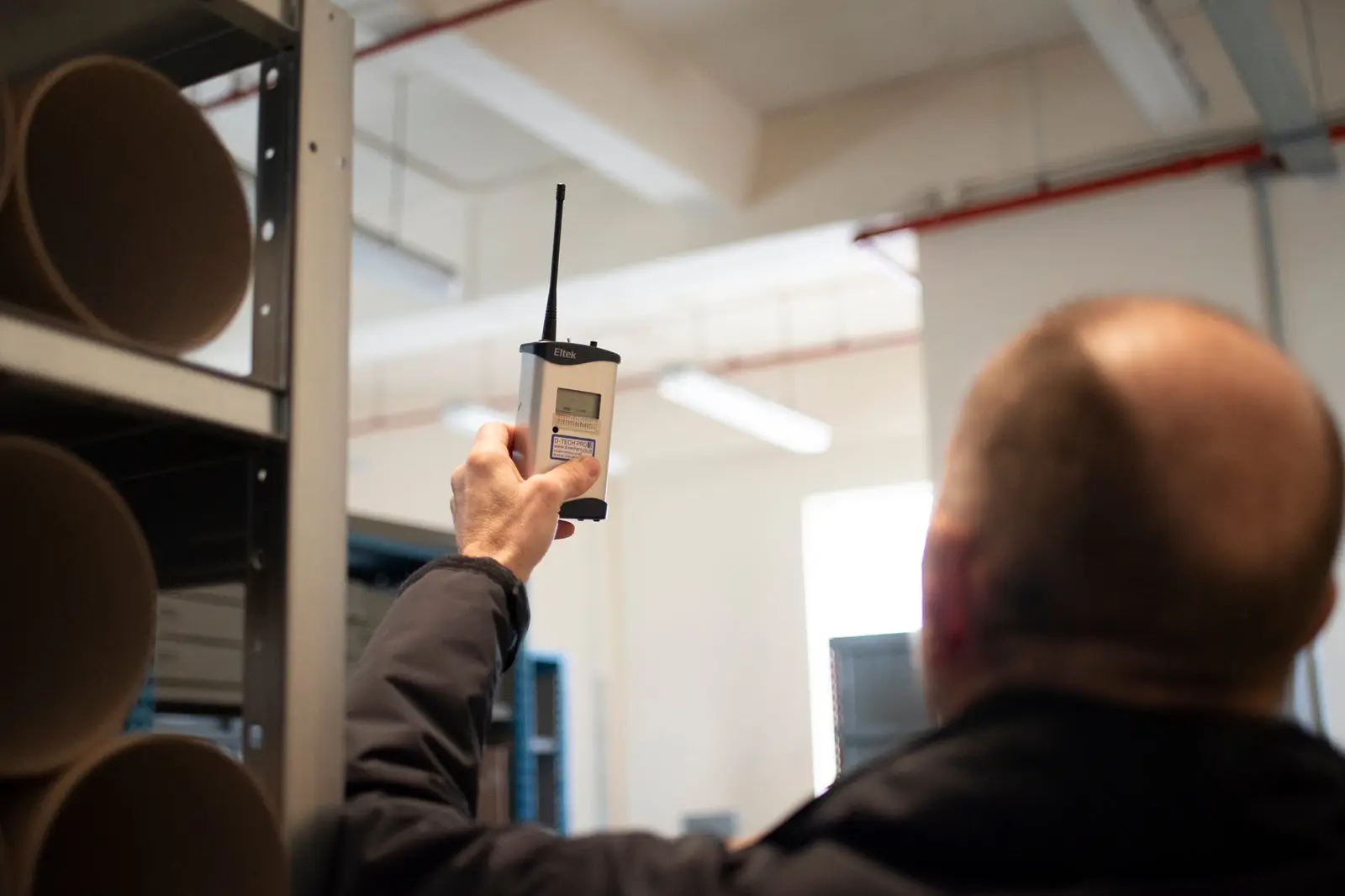
Wireless monitoring is popular for good reasons: no cable runs through occupied rooms, listed buildings or clean areas; sensors that move when your layout changes; installation measured in hours, not weeks. But a wireless link you can’t see is easy to take for granted, until a thick wall, a steel rack or a closed fire door quietly drops a sensor off the map. This is the problem a resilient, mesh-style wireless network is built to solve.
Why a single wireless link is a single point of failure
The simplest wireless setup is point-to-point: every sensor talks directly to one receiver. It works beautifully in an open, single-room deployment. The trouble starts as soon as the real world gets in the way. Radio signals are attenuated by dense materials: masonry, concrete floors, metal shelving, foil-lined insulation, even large volumes of water or product. Put a transmitter behind two of those and its direct path to the receiver can weaken to the point where readings arrive late, or not at all.
When there is only one path, there is only one thing to go wrong. Move a rack, prop open a lead-lined door, add a new partition wall, and a sensor that reported perfectly last month starts dropping readings, usually without anyone noticing until an audit or an incident asks for the data that isn’t there.
What a wireless mesh actually does
A mesh-style network removes that single point of failure by giving readings more than one route home. Instead of every sensor depending on its own direct line to the receiver, the network uses intermediate nodes, repeaters, to relay data onward. A transmitter that can’t reach the receiver on its own hands its readings to a nearby repeater, which passes them along. Add a second repeater and a link that fails can be picked up by another path rather than lost.
The practical effect is coverage that bends around obstacles and reaches places a single transmitter never could: the far wing of a building, a basement plant room, an upper floor, a cold store with metal walls. You are no longer limited by the weakest direct link, you are limited by the network as a whole, which is far more forgiving.
Repeaters extend range and re-route around obstacles
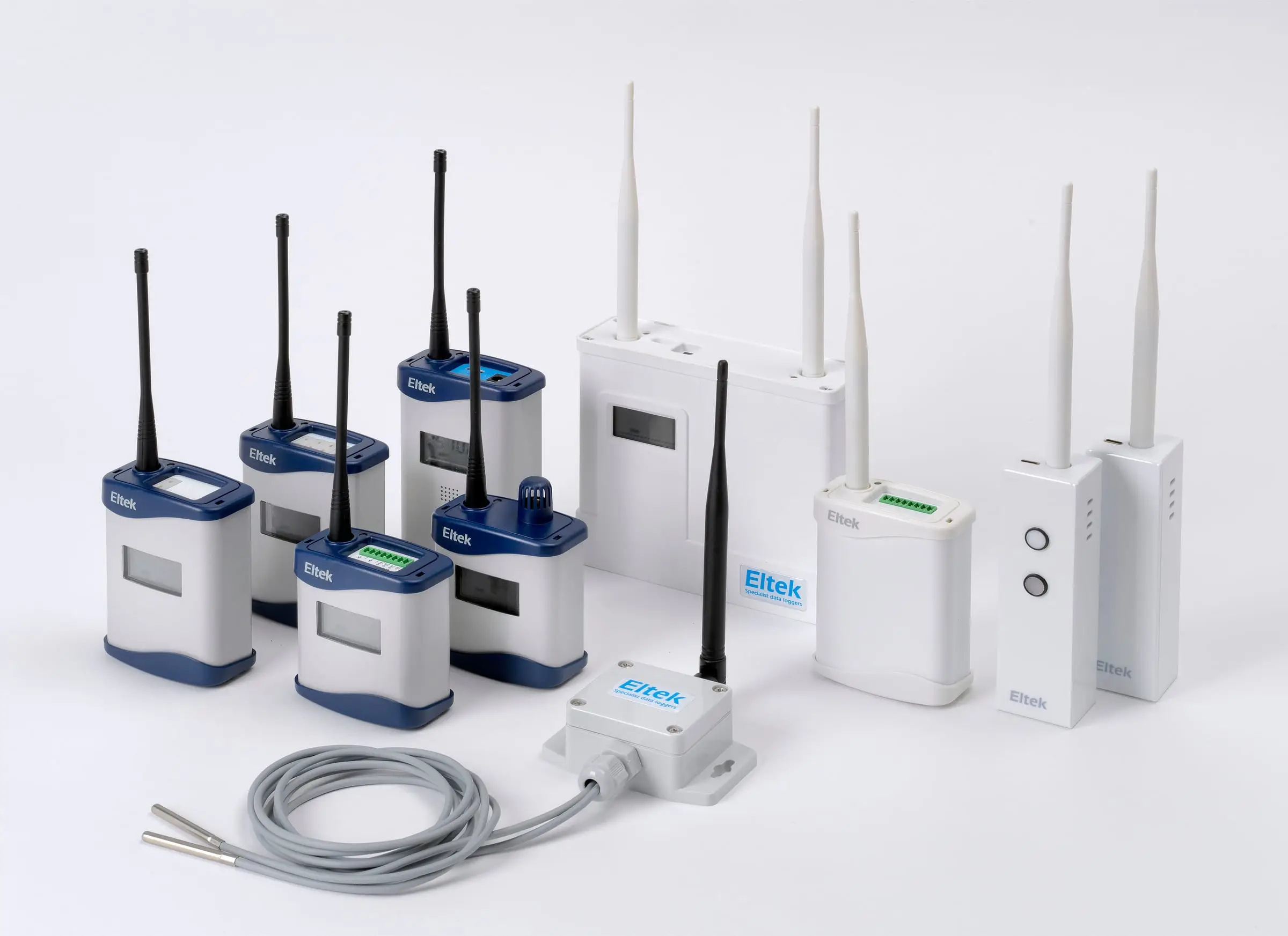
A repeater is a simple idea doing important work: it receives a transmitter’s signal and re-broadcasts it, effectively lengthening the reach of the network hop by hop. Eltek’s RP250-USB repeater is a mains-powered unit with rechargeable battery backup and a detachable antenna, so it keeps relaying through a short power interruption and can be positioned, or antenna-extended, for the cleanest line of sight. Placed at the edge of reliable coverage, a repeater turns a marginal link into a solid one.
How Eltek builds resilient wireless networks
Eltek’s Darca Solutions Suite is designed around exactly this principle. Battery-powered GenII wireless transmitters sit at the sensing edge, taking temperature, humidity, light and other readings and sending them over a licence-free UHF radio band chosen for good building penetration. Where a direct path is weak, RP250-USB repeaters extend and re-route coverage. At the centre, a receiver-logger, the SRV450, with 4G mobile connectivity, gathers the incoming data and relays it on to the Darca software for dashboards, alarms and reporting. The SMS450 adds grouped SMS alarm messaging so the right people are told the moment a reading goes out of range.
Local buffering: a dropped link delays data, it doesn’t lose it
Resilience isn’t only about radio paths, it’s about what happens when connectivity is genuinely interrupted. Eltek’s loggers store readings locally and forward them when the link is restored, so a network hiccup or a power blip produces a short delay rather than a hole in the record. In a low-temperature biobank we monitor at a leading UK university, this delivered continuous logging with no data gaps, even during network interruptions, the difference between a complete, auditable history and a record with unexplained gaps.
Coverage across large and complex sites
The clearest proof of a resilient wireless design is a hard site that has run for years. At Canterbury Cathedral, an Eltek system of around 70 wireless transmitters reporting across roughly 200 measurement channels has monitored the building fabric, paintings, stained glass and local weather, through metres of medieval stone, in continuous operation since 2007. Few environments are less forgiving to radio than a cathedral, and few applications less forgiving of missing data than the conservation of irreplaceable heritage.
That same architecture scales down to a single lab and up across multiple buildings on a campus. Because the network is extended with repeaters rather than rebuilt, you can add sensors and reach new areas without re-engineering the system, the reliability model holds whether you are monitoring one cold store or a whole estate.
What reliability means for the data you can trust
A resilient network changes what you can say about your data. Instead of “these are the readings we happened to receive,” you can stand behind “this is a complete, continuous record.” That distinction matters everywhere monitoring exists to provide evidence, across life-science storage, GxP-aligned processes, museum conservation and cold chain, because a record with gaps invites exactly the questions an audit is designed to ask.
It also changes the economics of an alarm. Early-warning alerts are only as trustworthy as the link that carries them; a sensor that has silently dropped off the network can’t warn you about anything. Redundant paths and local buffering keep the alarm chain intact, so a genuine excursion reaches a human being while there is still time to act.
Designing a network you can rely on
Reliability is something you specify, not something you hope for. A few principles carry most of the load:
- Survey before you scale. Confirm signal strength at each proposed sensor location, not just near the receiver, before committing the full rollout.
- Add redundancy at the edges. The transmitters furthest from the receiver, or behind the most material, are where a repeater earns its keep.
- Design for change. Buildings get repartitioned and racks get moved; leave signal headroom so a small change doesn’t break a marginal link.
- Insist on local buffering. Make sure the logging hardware stores and forwards, so an interruption delays data rather than losing it.
- Verify continuity. Use the platform’s own health and alarm features to flag a sensor that stops reporting, before a gap becomes a problem.
Get those right and wireless stops being the fragile part of the system and becomes the reason it keeps working. If you’re planning coverage across a large or awkward site, or an existing wireless system is leaving gaps, our UK engineers can help you design a network that gets every reading home. Explore how we monitor demanding heritage environments, or read our companion guide to multi-zone monitoring in large facilities.
Key takeaways
- A single wireless hop is a single point of failure, so a resilient network gives each reading more than one way home.
- Repeaters relay readings around thick walls, floors and steel, so a transmitter that can’t reach the receiver directly still gets its data through.
- Local buffering on the logging hardware means a dropped link delays data, it doesn’t lose it.
- Eltek’s GenII system has run this way in demanding real-world sites for years, with around 70 transmitters across ~200 channels at Canterbury Cathedral since 2007.
- Reliability is a specification you can design for: plan coverage, add redundancy at the edges, and verify signal before you scale.
Need this in your facility?
Coverage across a large or awkward site is a design problem, not a guess. Tell us your building and what you need to monitor, and our UK engineers will map the transmitters, repeaters and receiver you need.
See how the Darca Solutions Suite worksGet more insights like this
Get monitoring insights in your inbox
Practical guidance on compliance and environmental monitoring: mapping, audit trails, probe selection and multi-site reliability. Occasional, useful, no noise.
Unsubscribe any time. Your details are never shared.