Guide
A Guide to Multi-Zone Monitoring in Large Facilities
How to design monitoring across zones, floors and buildings so nothing slips through the gaps, and every area stays audit-ready.
The Eltek Engineering Team8 min read
Advanced zone monitoring is the discipline of giving every distinct area in a large facility its own measurement points, alarm thresholds, and responsible team. A single freezer is easy to monitor. A hundred of them, across three buildings, two campuses and a dozen teams, is a different problem — and the risk is not usually the obvious asset everyone watches. It’s the forgotten corner, the plant room on the top floor, the store that changed use last year. Advanced zone monitoring technology exists to make sure nothing slips through the gaps.
What counts as a “zone” in advanced zone monitoring?
It’s tempting to draw zones on the floor plan, one per room, one per floor. A more useful definition is operational: a zone is an area that shares a condition you must control and an action you would take if it drifted. A −80 °C freezer bank, a temperature-mapped warehouse aisle, a gallery with a light and humidity spec, a clean room held to a pressure differential, each is a zone because it has its own limits, its own owner and its own response.
Defining zones this way keeps monitoring aligned with responsibility. When an alarm fires, it maps to a place, a person and a procedure, not just a sensor ID on a screen.
Counting channels: the practical unit of monitoring
Once your zones are defined, the design becomes a counting exercise. Every measurement point, a temperature here, a humidity there, a door state, a differential, is a channel. List the channels each zone needs, allowing for redundancy on the critical ones, and you have the real size of the system. It’s a more honest number than “how many rooms,” because one room might need a single reading and another might need a dozen.
How transmitters aggregate channels
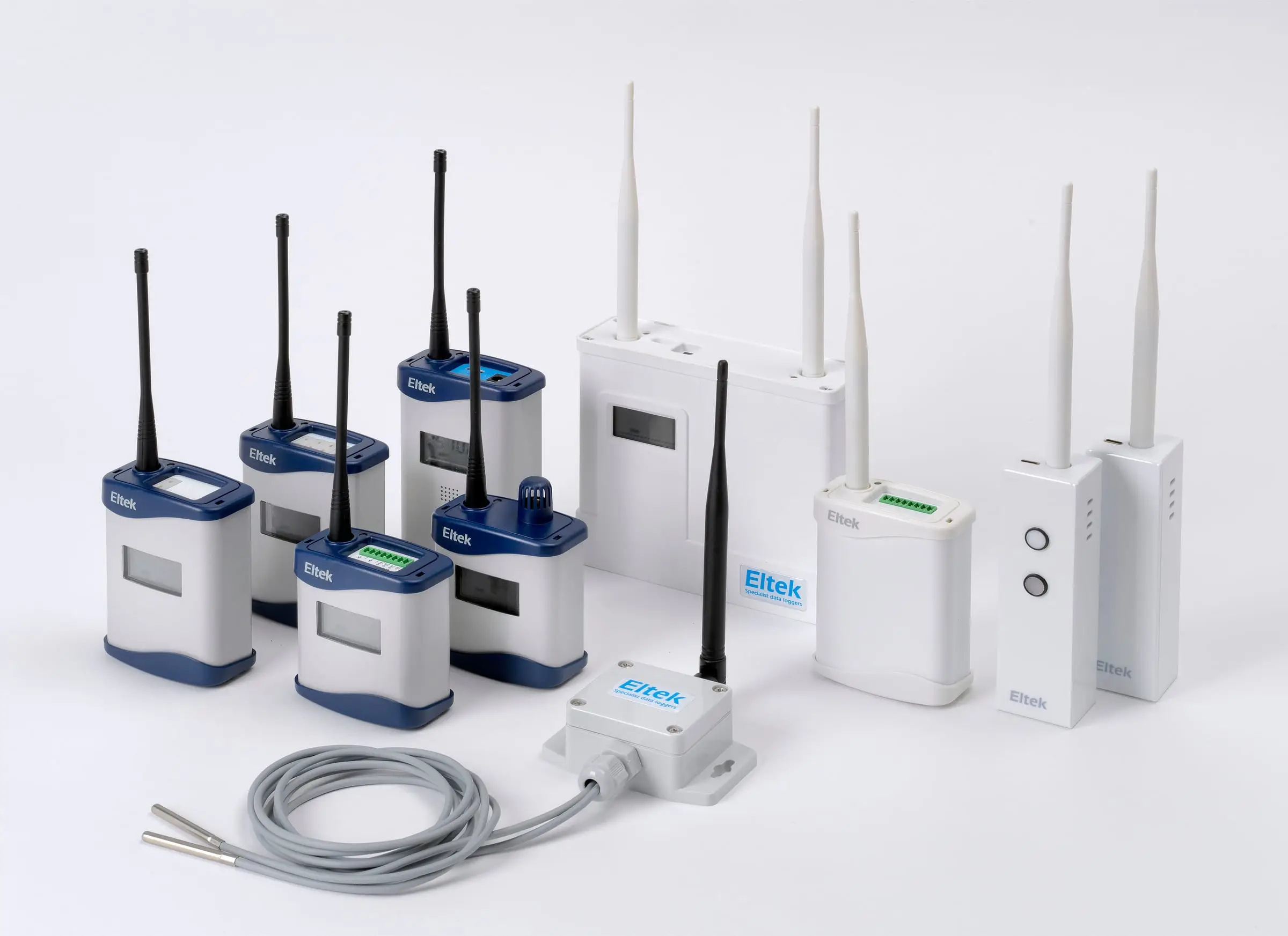
In an Eltek system, channels are grouped onto GenII wireless transmitters, each carrying several inputs: the GD34 takes four thermistor inputs, the GD24H four thermocouples, the GD52A two PT100 RTDs, and RH/T combinations cover humidity-sensitive zones. A handful of transmitters can therefore cover a densely instrumented zone, while a spread-out zone might use several single-purpose transmitters positioned for the best signal. The scale this reaches is real: at Canterbury Cathedral, around 70 transmitters carry roughly 200 channels across the whole building.
One platform across zones, floors and buildings
The failure mode of large-facility monitoring is fragmentation: a chart recorder in one room, a standalone logger in another, a spreadsheet someone updates by hand. Each is a silo, and the gaps between silos are where problems hide. The fix is a single platform.
Eltek’s Darca Solutions Suite brings every zone into one view. Battery-powered transmitters report wirelessly to a receiver-logger, the SRV450, with 4G connectivity, which relays to Darca Command for centralised, real-time dashboards across all your assets at once. Whether your zones sit in one building or span multiple sites, the people responsible see the same live picture, with the same limits and the same history, rather than logging into a different box for every room.
Designing alarm escalation people actually act on
In a large facility, an alarm that emails one inbox is an alarm waiting to be missed. Good multi-zone design layers the response:
- Stage the thresholds. An early “approaching limit” warning gives time to intervene before a true excursion; a hard alarm signals action now.
- Group and route by zone. Each zone’s alarms go to the team that owns it, so alerts land with the people who can act; Eltek’s SMS450 adds grouped SMS messaging alongside email for exactly this.
- Escalate on silence. If the first responder doesn’t acknowledge, the alert should climb to the next person. An unanswered alarm is not a closed one.
- Reach people off-site. The worst excursions happen overnight and at weekends; SMS and mobile connectivity keep the chain intact when the building is empty.
In a low-temperature biobank we monitor at a leading UK university, multi-stage email and SMS alarms turned monitoring from a manual check into an early-warning system, reducing the risk of sample loss by catching excursions while there was still time to respond.
Coverage without gaps
Multi-zone monitoring only works if every zone is actually reachable. Distance, dense construction and metal all attenuate wireless signals, so large sites use repeaters to relay readings around obstacles and extend coverage into basements, far wings and upper floors. Designing that resilient, mesh-style network is a subject in its own right; see our guide to how wireless mesh networks improve measurement reliability, but the principle is simple: a zone you can’t reliably reach is a zone you aren’t really monitoring.
Keeping every zone audit-ready
Scale multiplies paperwork. Manual checks that were merely tedious for one freezer become unmanageable, and unauditable, across a hundred. Continuous, centralised logging replaces the clipboard with a complete, time-stamped record for every zone, available on demand. That’s the difference between hunting for evidence before an inspection and simply producing it. For the compliance side of that record, see understanding compliance: from mapping to audit trails.
A design approach for large facilities
- Map zones by condition and ownership, not just geography.
- Count channels per zone, with redundancy on the critical points.
- Group channels onto transmitters and site them for signal.
- Plan coverage with repeaters so no zone is out of reach.
- Centralise on one platform for a single live view and history.
- Design escalating, grouped alarms routed to the right teams.
- Build in expansion, adding zones and sites without redesigning.
Done well, a large, complex estate feels as manageable as a single room: one dashboard, clear ownership, and confidence that every zone is covered. Explore how Eltek supports large industrial facilities and multi-site life-science operations, or talk your layout through with our engineers.
Key takeaways
- Define a zone by the condition you must control and the action you would take, not by the floor plan.
- Plan in channels: count the measurement points per zone, then group them onto multi-input GenII transmitters.
- Run every zone, floor and building on one platform: Darca Command gives centralised, real-time visibility instead of siloed loggers.
- Escalating, grouped alarms (email and SMS) make sure the right person is told, and told again if no one responds.
- Design for coverage and continuity first, so no zone becomes a silent blind spot.
Need this in your facility?
Mapping monitoring across zones, floors or sites is a design exercise. Share your layout and the conditions that matter, and our engineers will plan the channels, transmitters and alarms zone by zone.
Explore the Darca Solutions SuiteFrequently asked questions
What is advanced zone monitoring?
Advanced zone monitoring is an approach to environmental monitoring in large or complex facilities where each distinct area — a cold room, a gallery, a plant room, a production zone — is given its own measurement points, alarm thresholds, and responsible team. Rather than treating a building as one system, it gives each zone its own definition, channel allocation, and escalation path. Eltek implements this through wireless GenII transmitters grouped into named zones in Darca Command, with per-zone alarms and centralised reporting.
How does advanced zone monitoring technology work in practice?
Advanced zone monitoring technology combines multi-input wireless transmitters, a centralised receiver hub (Eltek's SRV450), and cloud-based monitoring software (Darca Command) to give every zone in a facility its own real-time view and alarm chain. Each zone's channels feed into one platform, so a facilities team can see all zones at once, investigate any zone in detail, and prove continuous compliance across the whole estate.
How many zones can an Eltek system monitor?
There is no fixed limit. At Canterbury Cathedral, around 70 wireless transmitters carry roughly 200 channels across the whole building, each mapped to a specific location or structural element. The architecture scales from a single room to a multi-building estate: zones are added by deploying more transmitters and repeaters, and all feed into the same Darca Command platform.
Get more insights like this
Get monitoring insights in your inbox
Practical guidance on compliance and environmental monitoring: mapping, audit trails, probe selection and multi-site reliability. Occasional, useful, no noise.
Unsubscribe any time. Your details are never shared.